

So you want to learn how to play guitar? Congratulations! In my humble opinion, learning to play guitar is one of the most rewarding things you can do. This free guide will teach you the 5 essential chords every beginner needs, how to tune your guitar, and how to get clean, clear sounds. No experience required.
What You’ll Learn in This Free Guide
- How to properly tune your guitar (the step most beginners skip)
- 5 essential beginner chords: Em, Am, G, C, and D
- How to read chord diagrams like a pro
- Tips for getting clean, buzz-free chord sounds
- Practice techniques that actually work
Timeline: With 10-20 minutes of daily practice, you can master these chords in 1-2 weeks and start playing simple songs.Cost: 100% free. No credit card, no catch.
Can I Learn How To Play Guitar?
I had the good fortune of learning guitar when I was a teenager; however I’ve found that there are many people out there who are much further along in life, and are now wondering if it is even possible for them to learn at their age.
I’d like to answer that with a resounding YES!

YES! It is possible for you to learn to play guitar, regardless of your age. The oldest student of mine that I’ve heard from was 93… just starting to learn how to play guitar, and LOVING IT! The biggest hindrance to learning how to play guitar, at any age, is the belief that you’re not able to do it. So, if that thought has ever crossed your mind, toss it in the garbage can right now, and let’s move on.
If you’re older, you might not be able to get as far on the guitar as you would have wished, and your fingers may work more slowly than they used to, but nevertheless, I guarantee you that you can still find many hours of enjoyment out of learning to play.
Learning to play the guitar is a life-long process; it will not happen overnight despite what many of the hucksters on the internet may tell you. As such, you are best to develop some reasonable expectations of how quickly you will progress. There will be challenges along the way (yes, your fingers will hurt!) and too many budding guitarists have given up prematurely, slid their brand new guitars under their bed, and walked away in disappointment… not realizing that they were oh-so-close to a breakthrough that would have taken them on to the next level. Having a mindset that allows for setbacks here and there will really help you in the long run, because you will find that through every challenge you come out a stronger player on the other side.
Okay – mindset is important folks! But, mindset alone will never get you playing guitar. So let’s dig in!
Get Your Free Personalized Lesson Plan
Take our 60-second guitar skills quiz and I’ll send you a custom lesson plan based on your current level – whether you’re starting from scratch or looking to level up your playing.
Tuning Your Guitar
I’ve seen so many guitar lessons where the instructor simply dives right in and begins teaching chords. Unfortunately, that assumes that the student’s guitar is already in tune! Guitars are made out of wood, and wood reacts to our environment, be it hot, cold, dry or humid. As such, guitars frequently go out of tune, and they must be tuned to make them sound good. If you begin learning to play guitar on an out of tune guitar, it will not sound good to the ear no matter how hard you try, and as such, it will become discouraging pretty quickly.
When you’re holding your guitar in your lap, the smallest string (closest to the ground) is called the first string. If you pluck it, you will hear it has the highest pitch of all six strings. From there, we move towards the sixth string, which is closest to your face. If you pluck that string, you will hear it has the lowest pitch of the six.
Now pick a string, any string, and pluck it open. Listen to the pitch. Now, press down on the string anywhere along the fretboard. You will hear the pitch of that string is now higher.
Thus, we learn that the terms higher and lower on guitar having nothing to do with physical position, but instead refer to the pitch that is produced by the position. If I say go higher, it doesn’t mean move along the strings towards your face, it means increase the pitch.
Ironically though, the highest string is also the first string, thus has the lowest number. Yeah, I know… it’s goofy, but it’s just something you have to learn quickly and deal with.
The most common tuning for guitar is E A D G B E. We start with the sixth string here, E, then go to A on the 5th string, and so forth. We call this standard guitar tuning.
You’ll need a guitar tuner to help you find the right pitch for each string. The good news is, a decent tuner can be had for $10-$20 these days. You might find my lesson on How To Use A Guitar Tuner helpful.
I recommend tuning your guitar before every single practice session, and if you’re playing for a while, double checking it in the middle doesn’t hurt either. If you find the guitar goes out of tune very quickly, it might be time for some new strings.
Your First Chord: E Minor (Em)
Alright, are you ready to learn your first guitar chord? It’s called an E minor. There are two basic types of chords you’ll come across, major and minor. Major chords don’t have anything after them, ie we just call them G, or C, or E etc. For minor chords however, we abbreviate the minor into just ‘m’ and add that onto the end of the chord. So, Em.
Here’s what it looks like:

Let me explain this diagram. The top corresponds to the nut on your guitar – that’s where the strings end, farthest from your body. Left to right, the strings are numbered 6, 5, 4, 3, 2, 1. The string on the left is the 6th string (low E).The O marks above the strings mean let that string ring out open. In some diagrams, you’ll see an X instead, which means mute that string.Em uses all six strings, which makes it perfect for beginners.The circles with numbers show where to put your fingers. For Em, place your 2nd finger on the 5th string, 2nd fret, and your 3rd finger on the 4th string, 2nd fret. The numbers inside the circles (2 and 3) tell you which fingers to use.
Don’t worry about strumming yet. Just focus on getting a clear sound from each string. Pluck each one individually – no buzzing, no dead notes. Just clean tone.
Second Chord: A Minor (Am)

The first thing to notice about Am is that you don’t play the 6th string! When you see those X’s, pay attention, because if you’re playing all six strings on a chord that doesn’t require it, the sound will be muddy and confused, and it won’t be pleasing to the ear.
So put your index finger, that’s your first finger (index = 1, middle = 2, ring = 3, pinky = 4) just behind the first fret of the 2nd string, then add your 2nd and 3rd fingers on the 4th and 3rd strings, respectively, just like the diagram.
Starting from the 5th string, pluck each string in order making sure to get a good clear sound out of each one. Don’t strum wildly, as you’ll never hear if you have a problem spot. Far better to learn how to make a clear sounding chord, and then learn how to strum. Your playing will improve more quickly that way.
Transition tip: Notice you used fingers 2 and 3 in basically the same arrangement for both Em and Am? From Em, move those two fingers down one string each, add your 1st finger on the 2nd string, and you’ve got Am. Spotting patterns like this makes chord changes easier.
Practice switching between Em and Am. Can you hear how good they sound together?While you can play songs with just these two chords, I know you want more. If you’re still working on Em and Am, that’s okay – they take time. Bookmark this page and come back when you’re ready for the next three. I’ll still be here!
Ready to Accelerate Your Progress?
Take the quiz and I’ll send you a customized lesson plan focused on exactly what you need to work on next, based on your current skill level.
The Three Major Chords: G, C, and D
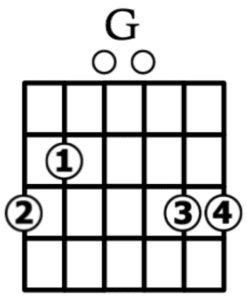
The first two chords (Em and Am) are among the easiest for beginners. Now we’re adding the three most important chords on guitar: G, C, and D. Together, these are the I-IV-V chords in the key of G major – which means they show up in literally thousands of songs. Master these five chords and you can play Brown Eyed Girl, Sweet Home Alabama, and countless worship songs. Checkout this list of songs you can play using G C D chords.

G Major Chord
G major is a stretch for most beginners, but it’s worth the effort. You’ve got two fingering options:3-finger version (easier): Middle finger on 6th string/3rd fret, index on 5th string/2nd fret, ring finger on 1st string/3rd fret.4-finger version (fuller sound): Add your pinky on the 2nd string/3rd fret. This takes more coordination but gives you a richer sound.Start with the 3-finger version. The most common problem? Your ring finger on the 1st string accidentally muting the 2nd string. Curl your finger so it comes straight down on the 1st string without touching anything else.
C Major Chord
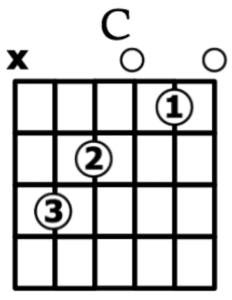
C major is often the hardest of these three for beginners. It requires a decent finger stretch, and the 1st string (1st fret with your index finger) loves to buzz.The trick: Press down firmly with your index finger right behind the fret – not on top of it, not way behind it. Right behind it. That’s where you get the cleanest contact.Transition tip from G to C: Your 3rd finger stays on the 3rd string throughout both chords – just moves from the 3rd fret (in G) to the 3rd fret of the 5th string (in C). Wait, that doesn’t work… let me rethink that.Actually, the best way to transition G to C: Use your ring finger (3rd finger) as a guide. In G, it’s on the 1st string. In C, it moves to the 5th string, 3rd fret. Let that finger lead the way, and the other two follow.
D Major Chord
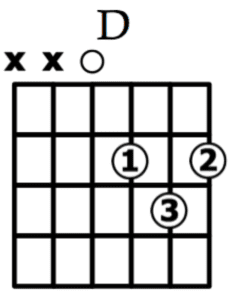
D major is the easiest of the three. It only uses four strings (don’t play the 5th and 6th – they’re marked with X). The shape forms a little triangle/pyramid that’s easy to remember.Watch out for: Accidentally hitting those 5th and 6th strings when you strum. This is super common. Practice hitting just strings 1-4 cleanly. You’ll develop a feel for it.
Chord Transition Practice Tips
Once you can play each chord cleanly, the real challenge begins: switching between them smoothly. Here’s how to practice:1. G ? C: This is the toughest transition for beginners. Place G, then very slowly move to C. Find the most efficient finger path. Your fingers don’t need to lift way off the fretboard – keep them close and hover to the next position.2. C ? D: Slightly easier because both chords have your 1st finger on the 1st string, 2nd fret. That can be an anchor point. Place that finger first in both chords, then add the others.3. D ? G: This shows up in tons of songs. Practice it relentlessly. Start slow – it’s better to make clean chord changes at 40 BPM than sloppy ones at 80 BPM.The practice routine: Pick any two chords. Strum the first one (one strum), count to four, change to the second chord (one strum), count to four, repeat. Do this for 2-3 minutes. When it feels comfortable, speed it up.You can switch between all five of your chords (Em, Am, G, C, D) in any order and they’ll sound good together. Why? They’re all in the same key family. But we’ll save music theory for another day.
Tips For Cleaner Sounding Chords
Here are some common reasons you’ll end up with muddy sounding chords:
- Not pressing hard enough on the string can cause the string to buzz where it touches to the fret.
- Pressing too hard on the string can put the note out of tune. You want to apply just enough pressure that you get a firm contact with the fret.
- Pressing too close to the fret that your finger is over top of it and deadens the sound of the string.
- Pressing too far behind the fret can give you a poor connection with the fret.
- One of your fretting fingers is interfering with another string.
There are many reasons why you might not get a good clear sound, but the short list above should give you a starting point. Also, I’ll stress again: when learning a new chord, pluck each string individually and re-arrange your fingers until every string in the chord rings through nice and clean and bright.
The Next Step
Alright, now you know five chords. But what’s next? How do you keep moving forward and improving on the guitar? If you’ve made it this far, I highly recommend joining my free email newsletter. As my thanks for signing up, I’ll send you a free ebook with all the best chords for a beginner to learn to play guitar with. As well, you’ll receive a free video lesson once a week that will dig into a particular technique or idea on the guitar. It’s tons of fun, and you’ll learn lots along the way! Sign up below…
What Should You Learn Next?
Take our 60-second guitar skills quiz and I’ll send you a custom lesson plan based on your current level – whether you’re starting from scratch or looking to level up your playing.
Helpful Tips
- If you are practicing regularly, like you should be (at least once a day) be sure to change your guitar strings once a month. You will be amazed at how much of a difference in sound quality a fresh pack of strings will make. You don’t need super expensive strings. When I was starting out, I got by quite happily on my local music store’s house brand of strings that cost about $4 a pack.
- Jam with a friend if possible.
- Don’t cram your whole practice time into one day per week. You’re far better off with a few 10-20 minute sessions during each day than you are with a monster multi-hour session on Saturday!
- If you’re working on a song, record yourself practicing. Then, listen back and critique yourself. Yes, it is hard to do because you’ll notice ALL your errors, but it is also a tremendously powerful technique that will propel you forward faster.
- If you find it hard to play your guitar, it probably is. Find a reputable guitar technician and get the guitar setup properly. Something as simple as adjusting the action can make a world of difference to how easily the guitar plays, and as a result, how much you’re going to want to play it!